


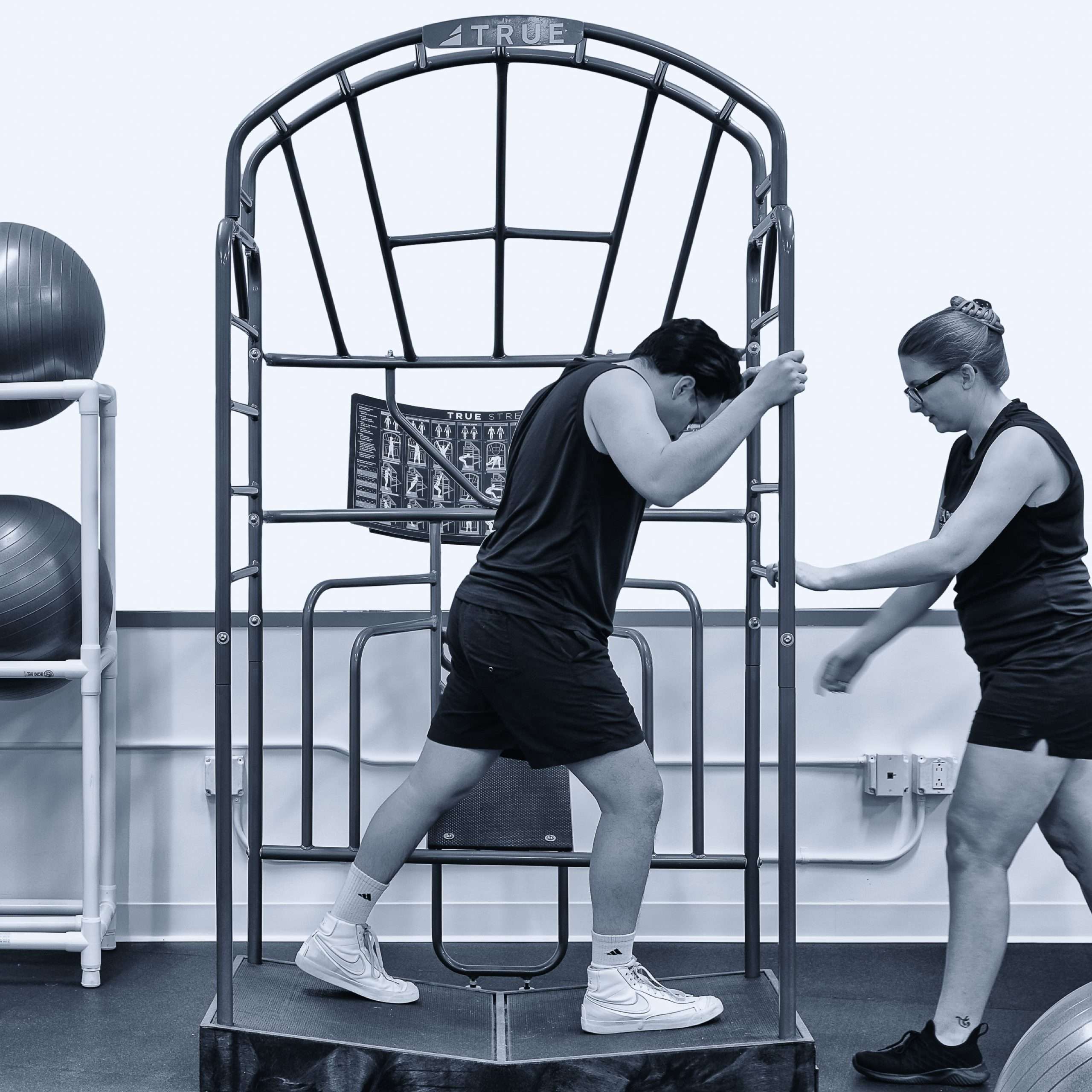
Dr. Jim Reising first connected with Casa Loma while getting his doctorate in physical therapy. He was asked to join the Advisory Board and floated the idea of doing some teaching work, so he was brought on as a guest lecturer and then adjunct faculty member. A few years later, he stepped into his role as Academic Coordinator of Clinical Education for the Physical Therapist Assistant (PTA) program, heading up the vitally important task of connecting with clinical practicum sites and matching each student with the right site for them.
We sat down to talk to him about his career, his responsibilities within our PTA program, and how he approaches preparing his students for their future careers.
What’s kept you motivated and engaged in this role?
I was in clinical practice for a long time, and part of that was running the practice, as well as patient care. I was getting to the point of retirement and decided I was going to stop juggling patient care and business operations, and I’d always had an idea that teaching might be something I’d be interested in doing. It just so happened that the timing coordinated well with the full-time faculty position becoming available.
That transition to a new phase of my career was motivating and engaging in and of itself. Trying to teach things that I had learned, trying to make it understandable to students who have had little experience and exposure to the field.
The academic coordinator position is challenging and rewarding because it’s a little bit of art, a little bit of science. It’s getting to know each of the students and their academic chops, if you will, and playing a matching game with different clinical settings and the personalities of different clinics to provide the absolute best clinical experience for each student.
What are the things you do within the PTA program?
I’m kind of a jack of all trades. I’ve got more years of experience than I want to admit—in outpatient orthopedics; geriatric care, which includes balance and fall risk issues; and acute care. So, I teach a little bit of a lot of different things in the program because I have varied experience, and I get a feel for the students by teaching.
Then, when it comes time for those students to go out into the clinics, we get together and try to decide what the best placement for each student is.
How do you find those sites?
Some of them were already established when I started. Some are sites that I have reached out to because of my clinical experience and my knowing different people in the community. So, you get the information, and then you reach out and ask if they have an interest in participating in the education of students.
It’s a salesmanship job. I never thought I was going to be into sales, but it’s sales in the sense that it’s face to face, talking to people and phone calls and emails.
Is there a unique selling point for Casa Loma College when you’re talking to these sites?
The feedback we get from other clinics is our students are well-prepared, and I believe that and try to sell it on that basis. I don’t know if we prepare them any differently, but I hear from our clinical sites that our students are better prepared than some other schools.
How do you maintain quality sites?
When we send students out, part of the required process is that we go out and visit the clinic and see the facilities and what they can offer our students. We talk with the coordinator on the clinical site, who is either going to be the clinical instructor or arranges for the clinical instructor. Additionally, we visit the students when they’re on a site to get their feedback on the site and the site’s feedback on the student.
If we get negative feedback, then we must assess: did we mismatch the student to a site? Or do we need to reconsider whether we want to use that site in the future? One thing we really try to avoid is our students are not supposed to be free labor for a clinic. They shouldn’t be treated like physical therapy aides, working for free. They’re PTA students; they need to be educated and prepared for working in the field.
Do you have a template of some kind that outlines for these sites what you want students to experience?
We give the course syllabus so they know what’s expected in the educational process, but there’s no specific template because you can’t expect every clinic to have every kind of experience.
One of the expectations our accrediting body has for us is that we give our students varied clinical experiences. So, they do three different clinical rotations: one short-term, one two-week rotation, and then a full-time practicum for about seven or eight weeks.
Are there any challenges that students report back when they’re out there?
From experience and our knowledge of the students and of the clinics, we hope to avoid unwanted challenges, but we do want them to be challenged in the proper ways. We want the clinical experience to be an educational challenge so that the student learns as much as possible. So, we do try to find clinical rotations that won’t be too easy for a student, so they stay engaged and won’t get bored.
Every once in a while, we’ll run into missteps. What we try to do is counsel the students first. We want them to do as much of the conflict resolution as possible and advocate for themselves. Because in the professional world, you get out there and you may run into conflicts with coworkers or supervisors. You can’t jump around from job to job every time you have a situation like that; you need to learn how to resolve it by advocating for yourself and doing it in a way that doesn’t create more conflict.
And do your students ever get hired by these clinical sites?
Frequently. We have a lot of students who get job offers towards the end of their clinical rotations, yeah.
Do you think the clinical education part of the program has evolved since you started?
Everything evolves over time. A lot of our inpatient clinical sites have been skilled nursing facilities, but one area where I think we’ve done a good job developing the past few years is pediatric opportunities. My vision is to develop more inpatient acute and inpatient rehab clinical sites, and that’s where we’re concentrating our efforts. There’s a need in those areas and a good opportunity for employment.
How do you stay connected with trends and changes?
I’m part of our professional association—the American Physical Therapy Association—and I’m involved in two sections there, one of which is their education section. So, I read their publications and follow along with their continuing education offerings. I attend conferences as well. I just recently was in Arizona for a conference and learning about exercise with blood flow restriction, which is a new thing that’s becoming a standard of practice.
I keep abreast of what’s going on, and part of that is just when I go out to the clinics to do site visits. You talk to these clinicians, and you’re able to keep your finger on the pulse of what’s happening in the PT world.
Would you say that there is a ‘typical’ PTA student?
They’re a diverse group, and I like that. I think it’s fun. One of the things I look for when I’m placing students is how many speak other languages. We have some clinics where speaking Spanish is a real plus. We’ve had a number of Armenian-speaking students and maybe there are certain clinics where speaking Armenian would be a plus.
Any success stories that stand out to you?
I like to think that every time we graduate a cohort of students, and they get hired in clinics, those are all success stories.
In a recent cohort, we had a student that had a very strong interest in the performing arts and dance, and I found a clinic that has an emphasis on performing arts and a lot of their patients are involved in dance professionally. So, I placed the student in that clinic, and he had a great experience, they were very appreciative of his skills, and it worked out really well.
What advice would you give to someone who’s considering becoming a physical therapist assistant?
I would advise that, if they’re considering it, they should try to get some experience prior to going to PTA school. I think that, if they know what the job entails and what they’re getting into, that’s an advantage.
How would you recommend they do that?
There are volunteer opportunities or observation hour opportunities or also paid employment as a physical therapy aide. That’s where a lot of our students actually come from, as aides who decide they want to take the next step and move into becoming a PTA. I think that’s a good path, so you know what you’re getting into.
